The situation
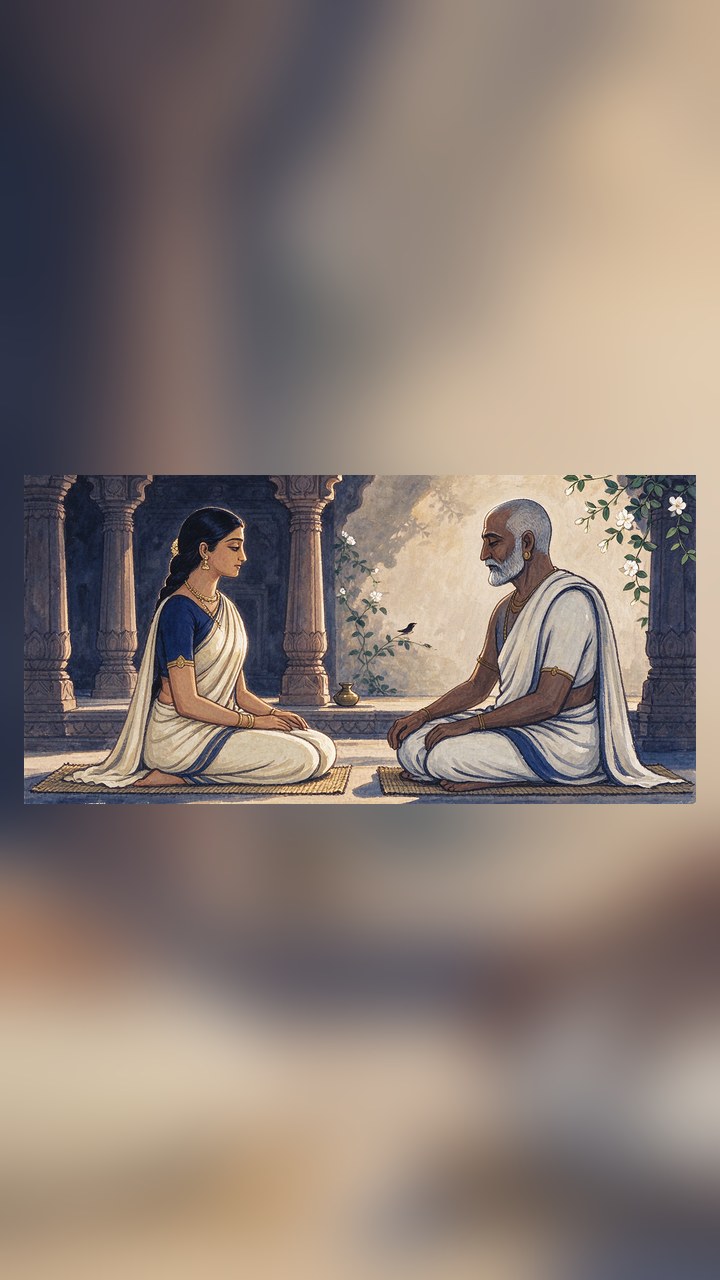
Yajnavalkya was preparing to leave household life. He told Maitreyi that he wished to arrange a settlement between her and Katyayani. Maitreyi responded with a question: if the whole earth, filled with wealth, belonged to her, would it make her immortal?
What happens
Yajnavalkya answered that she could live as those with ample possessions live, but wealth could not grant immortality. Maitreyi asked him to teach her what he knew about that deeper concern. He welcomed her inquiry and invited her to attend carefully to his explanation.
His teaching turned toward the Self. Spouses, children, possessions, and the world are dear, he said, for the sake of the Self. He urged Maitreyi to hear, reflect upon, and contemplate this Self, through whose understanding all this is understood. His examples linked particular sounds with their instruments and compared boundless awareness with salt dissolved throughout water.
How this episode ends
Maitreyi was bewildered by his words about knowing after death, and asked for clarification. Yajnavalkya explained that ordinary seeing, hearing, and knowing involve one being encountering another. But when all has become the Self, what other thing remains to be known, and by what means? He ended by asking how the knower, through whom all is known, could itself be known. The dialogue brings her question about immortality to the nature of the Self and knowing, without promising endless bodily life.
हिन्दी में पूरी कथा और सीख पढ़ें
प्रसंग की शुरुआत
याज्ञवल्क्य गृहस्थ जीवन छोड़ने की तैयारी कर रहे थे। उन्होंने मैत्रेयी से कहा कि वे उनके और कात्यायनी के बीच संपत्ति की व्यवस्था करना चाहते हैं। मैत्रेयी ने पूछा: यदि धन से भरी पूरी पृथ्वी उनकी हो जाए, तो क्या उससे उन्हें अमरत्व मिल जाएगा?
घटनाक्रम
याज्ञवल्क्य ने उत्तर दिया कि वे साधन-संपन्न लोगों जैसा जीवन जी सकती हैं, लेकिन धन अमरत्व नहीं दे सकता। मैत्रेयी ने उनसे अमरत्व का ज्ञान देने का अनुरोध किया। याज्ञवल्क्य ने उनकी जिज्ञासा का स्वागत किया और समझाते समय ध्यानपूर्वक मनन करने को कहा।
अब उपदेश आत्मा की ओर मुड़ा। उन्होंने कहा कि पति-पत्नी, संतान, संपत्ति और संसार की प्रियता आत्मा के लिए है। उन्होंने मैत्रेयी से आत्मा के विषय में सुनने, विचार करने और गहराई से ध्यान करने को कहा, क्योंकि आत्मा को समझने से यह सब समझा जाता है। उन्होंने अलग-अलग ध्वनियों को उनके वाद्यों से जोड़कर समझाया और असीम चेतना की तुलना पानी में सर्वत्र घुले नमक से की।
इस प्रसंग का परिणाम
मृत्यु के बाद जानने के विषय में उनकी बात से मैत्रेयी उलझन में पड़ीं और उन्होंने स्पष्टीकरण माँगा। याज्ञवल्क्य ने समझाया कि सामान्य देखने, सुनने और जानने में एक किसी दूसरे को जानता है। लेकिन जब सब आत्मा ही हो जाए, तब जानने के लिए कौन-सी दूसरी वस्तु बचेगी और उसे किस साधन से जाना जाएगा? अंत में उन्होंने पूछा: जिसके द्वारा सब जाना जाता है, उस जानने वाले को किससे जाना जाए? संवाद अमरत्व के प्रश्न को आत्मा और ज्ञान के स्वरूप तक ले जाता है; शरीर के अंतहीन जीवन का वचन नहीं देता।
कथा की सीख / विचार
मैत्रेयी स्पष्ट करती हैं कि वे कैसी पूर्णता खोज रही हैं और उत्तर कठिन होने पर अपनी उलझन भी सामने रखती हैं। उनका उदाहरण उद्देश्यपूर्ण प्रश्न और ईमानदार प्रतिप्रश्न करने का साहस देता है।