Travel through past, present and future. Explore how Hindu texts describe cycles of time, Earth and sky, and 14 lokas.
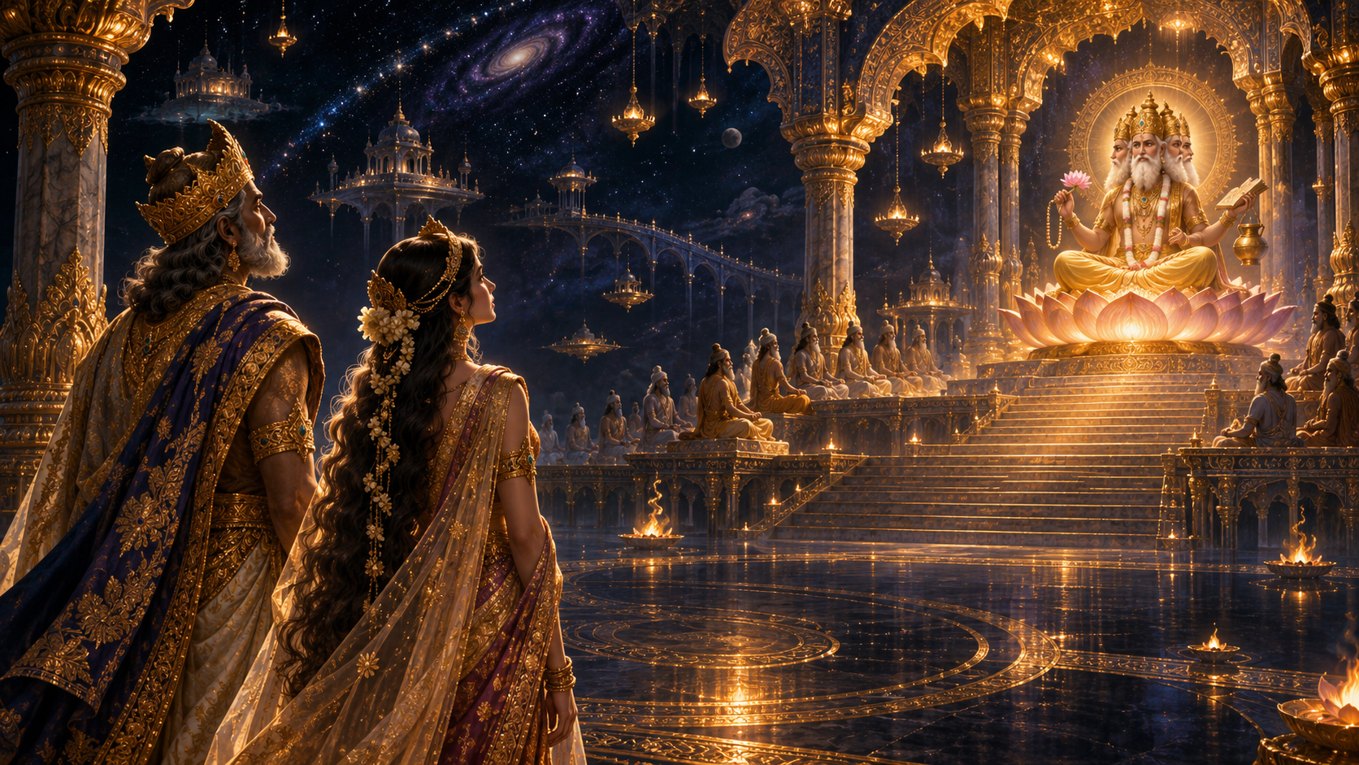
Kakudmi and Revati at Brahmā’s court · DIVYA illustration
Take the Time Traveller’s journey
Imagine you have a notebook that opens at three moments. At each stop, a story or a question helps you work out what changed and what you can do next.
Remember what came before
भूतकाल में हम पूछते हैं कि पहले क्या हुआ था।
At the first stop, you meet Kakudmi and Revati before their journey to Brahmā. They know the families, roads and customs of their own age. Picture what you would write down about your home if you might return to find it changed.
वर्तमान में हम देख सकते हैं कि अभी क्या बदल रहा है।
Back on Dhartī, choose something you can observe today. Look for the Moon on two clear evenings and sketch its position and shape. A calendar helps compare observations made at different times.
भविष्य के बारे में सोचकर हम आज के काम चुन सकते हैं।
Now picture the tree you could plant this year and the shade it might give a later generation. What must happen between seed and shade? Changing your actions now can change the possibilities ahead.
Past, present and future locate an event relative to now. Ādi and Ant mark the beginning and end of the event or cycle you are following. Samay is the time through which it unfolds.
Ādi आदि
Beginning. A seed is planted. Choose the moment where your story starts.
Samay समय
Time. Seasons pass and the seed grows into a tree. Kāla (काल) is another word for time.
Ant अंत
End. The old tree’s life ends. Its seeds may begin another cycle. The Sanskrit form is anta.
Bhūta-kāla means past time. Bhūta by itself can have other meanings in Sanskrit, depending on the passage.
Read the four yugas on a scale
A mahāyuga is a cycle of four ages. Drag the marker or choose an age to see where it begins. The width of each band shows its share of the cycle.
Ādi · startAnt · 43,20,000 years
Satya (Kṛta) Yuga
0 years from the start of the cycle
17,28,000 years in this age.
Age
Traditional years
Share
Satya (Kṛta)
17,28,000
40%
Tretā
12,96,000
30%
Dvāpara
8,64,000
20%
Kali
4,32,000
10%
In the Bhagavad Gītā, a day of Brahmā spans 1,000 cycles and the night spans another 1,000. Using the Bhāgavata durations, that makes 4.32 billion years for the day and 8.64 billion for day and night together. These are scales of time in Hindu cosmology.
चारों युग मिलकर एक महायुग बनाते हैं। ब्रह्मा का एक दिन ऐसे एक हज़ार चक्रों के बराबर बताया गया है।
Imagine looking up from where you stand. The Taittirīya Upaniṣad connects three sacred utterances with Earth, the region between Earth and Heaven, and Heaven. It adds Mahaḥ as a fourth utterance and offers further layers of meaning.
Dhartī धरती
Earth underfoot. Bhū or Pṛthvī are traditional Sanskrit terms associated with Earth. The passage connects Bhūḥ with this world.
Antarikṣa अंतरिक्ष
The intervening region associated with Bhuvaḥ in this passage. A modern Hindi speaker may also use antarikṣa for outer space.
Ākāśa आकाश
Sky or space, depending on the context. In the passage the term associated with Suvaḥ is asau lokaḥ, “that world,” understood there as Heaven.
A loka is a world or realm. Select a stop to see how the Bhāgavata describes it. The diagram follows one Purāṇic arrangement. In this diagram, up and down show the order of the realms in this telling. Other Hindu texts and traditions group realms differently.
Bhūloka
The Earth realm, the familiar point of departure for the Time Traveller.
Read all 14 descriptions
Satyaloka सत्यलोकThe highest realm in this list, associated with Brahmā. Kakudmi’s story gives a narrative reason for visiting Brahmā’s court.
Tapoloka तपोलोकA higher realm whose name evokes tapas, the discipline or austerity of sages.
Janaloka जनलोकA higher realm between Mahar and Tapa in this teaching map.
Maharloka महर्लोकThe realm that this scheme places above Svar and below Jana.
Svarloka स्वर्लोकA heavenly realm. The Bhāgavata calls it Svarloka. The Taittirīya Upaniṣad uses Suvar for “that world,” understood as Heaven.
Bhuvarloka भुवर्लोकThe intermediate realm between Bhū and Svar in this scheme. Compare the term antarikṣa in the Upaniṣadic diagram.
Bhūloka भूलोकThe Earth realm, the familiar point of departure for the Time Traveller.
Atala अतलThe first of the seven lower realms named in Bhāgavata Purāṇa 5.24.
Vitala वितलThe second lower realm. The Bhāgavata associates this realm with Hāṭakeśvara, a form of Śiva.
Sutala सुतलThe realm of King Bali. The Bhāgavata tells how Vāmana grants Bali a place here after Bali offers all he has.
Talātala तलातलThe fourth lower realm, associated in the Bhāgavata with Maya, an accomplished builder.
Mahātala महातलThe fifth lower realm, described in the Bhāgavata as a dwelling of serpent beings.
Rasātala रसातलThe sixth lower realm. The Bhāgavata associates it with Daityas and Dānavas.
Pātāla पातालThe seventh lower realm in this list, associated with Nāgas. The chapter describes these lower realms as richly furnished places.
लोक का अर्थ यहाँ एक जगत या क्षेत्र है। यह पुराणों की कथा-परंपरा का मानचित्र है।
King Kakudmi wants his daughter Revati to marry someone worthy of her. They travel together to Brahmā’s court to ask his advice. Celestial musicians are performing when they arrive, so Kakudmi and Revati wait for the music to end.
When Kakudmi asks his question, Brahmā explains that twenty-seven cycles of four yugas have passed on Earth. The people the king had in mind are long gone. Brahmā suggests Balarāma. Father and daughter return to a changed world, and Revati marries Balarāma.
DIVYA reflection: When circumstances change, listen, take stock, and be willing to make a new plan.
ककुद्मी और रेवती ब्रह्मा के पास गए। वहाँ थोड़ी देर प्रतीक्षा करने पर भी धरती पर सत्ताईस महायुग बीत चुके थे। लौटने पर उन्हें अपना नगर बदला हुआ मिला। बाद में रेवती का विवाह बलराम से हुआ। सीख: समय और परिस्थिति बदलें तो अपने निर्णय पर फिर से विचार करें।
Retell it together: Imagine a page in Revati’s notebook. What would she ask Brahmā? What might she notice first when she comes home?
Source note: This family retelling follows Bhāgavata Purāṇa 9.3.28–36. The Time Traveller’s notebook is a DIVYA learning device.