Jyotiṣa
Jyotiṣa sky calculator
Find daily timings for your city →
ज्योतिष और पंचांग
Move the Sun and Moon to see how a pañcāṅga derives tithi, karaṇa, nakṣatra and yoga. Then meet Chandra and Rohiṇī.
Move the Sun and Moon
Both angles are longitudes measured from the same zero point on the sidereal (nirayaṇa) zodiac. Use the sliders, enter an angle, or pick an example. The 27 divisions on the dial show where a nakṣatra begins and ends.
Gold · Sun · Silver · Moon · 0° at the top
- Moon ahead of Sun
- 25°
- Tithi
- 3 · Śukla (waxing)
- Karaṇa
- Taitila · half 5 of 60
- Nakṣatra
- Bharaṇī · pāda 1
- Yoga
- 1 of 27 · sum 5°
The examples use input angles. A daily pañcāṅga uses computed positions and conventions for a date and locality. When the Moon is at 15° and the Sun is at 350°, count 10° to zero and a further 15° to the Moon.
सूर्य और चंद्रमा के देशांतर बदलकर देखें। दोनों के कोणों का अंतर तिथि बताता है। चंद्रमा की स्थिति से नक्षत्र पता चलता है।
What the five parts measure
| Part | What changes it | What to try |
|---|---|---|
| Tithi · तिथि | Each 12° of directed separation from the Sun to the Moon begins one of 30 lunar days. | Leave the Sun at 0°. At exactly 12° separation, Śukla Dvitīyā (tithi 2) begins. A tithi can change at any time. |
| Karaṇa · करण | Each 6° of that same separation begins one half of a tithi. | Move the Moon from 5° to 6° and check what stays the same. |
| Nakṣatra · नक्षत्र | The Moon’s longitude falls in one of 27 equal sectors of 13°20′. Each sector has four pādas. | Move the Moon from 13.33° to 13.34° to pass from Aśvinī to Bharaṇī. |
| Yoga · योग | Add the two longitudes and place the sum, reduced to one circle, in one of 27 equal sectors. | Hold the Moon still and move only the Sun. Yoga can change while nakṣatra stays the same. |
| Vāra · वार | The weekday. Traditional daily reckoning links the day to local sunrise. | Find today’s weekday in the daily calendar for your locality. |
Calculation reference: Rashtriya Panchang, Positional Astronomy Centre.
Why Chandra kept returning to Rohiṇī
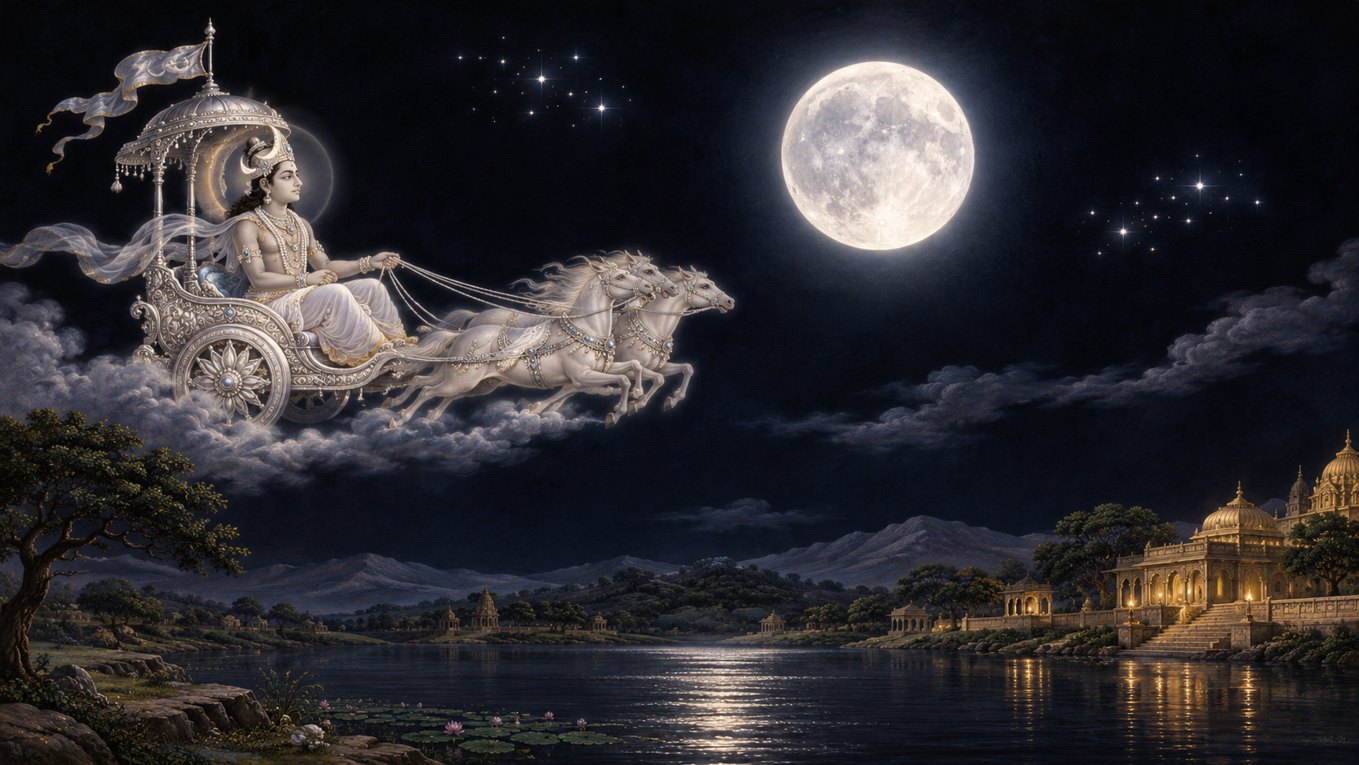
In a traditional account, Dakṣa’s twenty-seven daughters marry Chandra, the Moon. Chandra spends more time with Rohiṇī. The other wives speak up about being overlooked. In the Mahābhārata they ask Dakṣa for help. Dakṣa curses Chandra, who grows weaker. Chandra seeks a way to recover. Retellings tell this part in different ways, including versions tied to the Moon’s waning and waxing.
Moral: Give people the attention you promised them. Favouring one person can hurt people you overlook.
चंद्रमा ने रोहिणी को अधिक समय दिया। बाकी पत्नियों की उपेक्षा हुई और दक्ष ने चंद्रमा को शाप दिया। सीख: जिनसे वादा किया है, उनके प्रति न्याय और ध्यान रखें।
Retell it together: How could Chandra have responded before Dakṣa became angry?
Story source: Bhāgavata Purāṇa 6.6.23 and its commentary, 6.6.24 on recovery, and Mahābhārata, Śalya Parva 35.